My Way: Andy Evans
Excellence in British artistry has to a large degree been the dominion of the outlier, from Vivienne Westwood to Francis Bacon – and as far back in time (or up to today) as you want to go.
If the British skateboarding scene today is distinct in some ways, then it is so because of its own outliers – the mildly eccentric enthusiasts who do their own thing at a tangent to consensus, and the conformity that consensus wraps itself in like a Moncler gilet.
Andy Evans belongs to Brighton. The British skate videomaker has a portfolio which runs to a BAFTA and videos for industry behemoths like Vans and 411, but is better known for his series of slightly madcap independent UK videos spanning the last 20 years or so: For Display Only, Every Half-Hour, Misunderstood, Venturing Into The Void, Good Clean Fun, Chillin, As If, Straight To Video, Straight To DVD, This ’n That, Heel Toe Magic and Just In Time. Each of his videos are characterised by unpretentious snapshots of British skateboarding from that moment of time, usually interspliced by some fairly hammy acting and the kind of buffoonery that you could draw a line to from the Goon Show, Monty Python or even the Fast Show more recently. On top of that, he has filmed a series of standalone sections with British skaters who don’t fit the tramline mould. As a celebration of that great tradition of British cultural wayfarers, we thought it would be an excellent idea to corner him in a cul-de-sac until he told us his innermost thoughts on all matters skateboarding-related here and now.
Here’s what the last man standing had to say about…
…why independent skate videos matter.
That’s a really good question. For me, it’s what builds a genuine community in the skateboarding world, as the skaters and the filmers are on the same page: doing it just for fun, having a great skateboarding experience and journey. This makes for the best outcomes. I feel it’s important to keep it away from the corporate hand at times, as in the last few decades, there’s been more interference and dilution of projects to make things ‘on brand’- so it’s been difficult for anything unique to penetrate the corporate filter. Over the years, companies have been afraid to risk anything that breaks the mould. The result’s been homogenised output which, unfortunately, has influenced nearly all media output heavily. I feel that anything done independently that could break those norms and push things in a more interesting direction is very important.
…including event footage in his scene videos.
Well, I think that, initially, I set out to document what was around me in the skate world and not curate it into something artificial. If we’re being honest, so much of the most amazing skateboarding happens in skate parks, events, etcetera – so I never wanted to exclude it. If anything, I wanted to lean into it harder, as it was the stuff that excited me the most. There’s this idea that street footage is more valuable due to the effort needed to get it: the skaters’ struggle narrative… it’s very romantic, but I never completely bought into it because I thought that what you value depends on so many variables. The videos I grew up watching always had a good mix of terrain, people and genres, which I thought showcased skateboarding at its very best- so I chose to continue pursuing that direction.
…what makes Brighton unique.
It really is an anomaly in the UK and has one of the richest skate histories of any UK city. It’s like the UK’s Venice Beach- but with more rain, and worse waves. Someone called it ‘the budget Dogtown’ the other day, which amused me greatly. It’s a little pirate-y, but there’s a funny side to it, too; and some of the local characters here you really couldn’t make up. For me, that’s its most unique quality. It’s provided me with a great deal of wonder and amusement over the years. So many influential skaters and trends have come from Brighton. There is something about this place which makes it a particular hotbed of UK skate culture that I just can’t completely put my finger on- but… maybe if I could, it would make it less special.
…his favourite skit from any of his videos.
If I had to choose, it was the one with Mike Wright and Ben Powell:‘The Sixteenth Century Skater’.To crash skateboarding into a different time period was hilarious and Ben sold the character brilliantly. He deserves multiple Oscars for it. The way he tied historical references into contemporary skateboarding was a joy to behold. “360 flip over two Spanish galleons …didn’t even film it” was one stand-out. My favourite, though, was Mike opening a Biffa bin to reveal Ben in pantaloons and a ruff. When questioned what he was doing, Ben replied “What does it look like? I’m keeping it real, dickhead!” It was a poetic moment that summed up so much in one scene than I could have ever hoped for. Ben also told me that Mark Appleyard liked it so much that, whenever he sees Ben, he shouts ‘Tapestry, Bitch’ at him. That’s one of the best things from the skits: they have, over the years, acquired a bevy of unpredictable responses and happenings because of them which never fail to make me smile.
…what he looks for in a subject for a standalone video part.
It became more interesting to focus on individuals a lot more; you feel you can really tap into their world, and what they can do on the whizzplank. I need to be interested in them, in terms of skating or personality, and that’s not hard. There are loads of outstanding individuals around – but I’m drawn to the fringes a lot, I’d say… I chose Ellis Frost because of his uniqueness and his ability to utilise his slightly below-par skate park in such creative ways. On top of that, he’s the antithesis of ‘core’ because he’s a YouTuber and did the most ‘illegal’ manoeuvres which were so mind-blowing in technicality that my socks were blown off on a regular basis. That ticked a lot of boxes for me. I liked Diggs (English) because he’s a stonecold ripper with amazing style and tricks far beyond his years. To have such an amazing skater come from such a tiny village seemed highly unlikely – but here he was, tearing it up. Also, he has an amazing family with a wicked sense of humour – and a bed that turned into a mini-ramp. I admired Oska Sullivan for being one of the most technical mini-ramp skaters that I had ever seen with my eyes. He’s up there with Greg Nowik. I’m still shocked by what he managed to pull out of the trick bag during our filming: it was truly gob-smacking. I’m really so honoured that these skaters would invite me into their amazing worlds to document what they do. That’s something I’ll never take for granted.
…whether podcasts should have Simple Minds’ “Don’t You Forget About Me” as their theme tune.
(Laughs)- I think that I know what you’re saying, here… I guess that there’s been a glut of skate podcasts at the moment; some more interesting than others. You probably see this in all walks of life – you only have a certain amount of time in the sun, so I can see why people want affirmation for what they’ve contributed in the skate world, tied up in a podcast. It’s totally understandable – and I know that emotion. I do think it’s nice if recognition comes – and there are a lot of deserving people, but it shouldn’t be forced… if possible.
…his thoughts on social media.
I’m actually on the steam-powered social media of Facebook, so I can’t claim that I’m completely off social media. If what you mean is Instagram or TikTok… I’ll be honest: photographer Chris Johnson told me that Instagram was shit early on, so I put it out of my head. By the time it started ‘popping off’, as the kids say, I was behind the curve so I thought that I wouldn’t bother. Also, it looked quite noisy and I think that I wanted a less scrolling-based life. Social media definitely has its yins and yangs, but I prefer to be a bit less involved on the whole. Given what I do, people find that to be weird – but it does appeal to my default contrarian tendency, of course. I find that if anything is worth seeing, it will come into my view sooner or later; usually via Lucy Adams, or Greg Nowik.
…vert skaters seeing the skateboarding game differently.
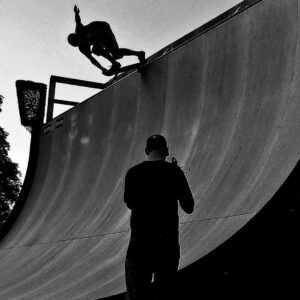
You’re right about this. It comes from how they’ve been ostracised from mainstream skate culture for so long that they find themselves seeing it in a more critical manner. They aren’t confined by the tyranny of cool, so they can offer a free view into the gatekeeping madness and trends that can infect the scene at large. I’m going to make a controversial statement, now: vert is one of my favourite things to film. I love the skater’s process of doing the tricks and to film them is just awe-inspiring. It’s definitely different to other types of skating, filming-wise. Even though the process for filming tricks is quite pre-meditated, it still has a surprisingly spontaneous side. There’s a strong moment when the energy shifts and the door of possibility is wide open which has made for so many memorable moments over the years.
…if gatekeeping is dying out of British skateboarding.
That’s another good question. I feel that it’s been diminished, somewhat, due to the internet giving people the ability to self-publish or self-promote… but I wonder if it’ll ever really die. I think that it’s shifted a little, and now I see it more around the organised side of Olympic-type skating and maybe even in a skate-political sense. People who are drawn to gatekeeping recognise that the same familiar mechanisms are employed in these areas – they previously used to discount someone for doing incorrect tricks and wearing incorrect trousers, so it seems a fairly easy transition for them. I think that, on some levels, the need to gatekeep is always going to be there – but whether it’s fair or not will always be debatable. To be honest, you wouldn’t want gatekeeping to disappear completely, since it provides the creative friction – to push against the norm – that’s driven many of the most interesting creative things in this world.